
Running a private medical or dental practice in the United States is a demanding job. Whether you are a Medical Doctor managing a busy outpatient center or a dentist running a growing clinic, your main focus is always on patient care. However, in today’s market, even the best clinical reputation needs strong support online. Almost every new patient starts their journey by searching for a local specialist on their smartphone. If your website is slow, you are likely losing these patients to the clinic down the street before they even see your name.
In the world of digital marketing for healthcare, website performance is no longer just a technical detail for your IT team. It is a core business metric that directly controls how many new patients find you and book an appointment.
How Local SEO and AI Connect Patients to Your Practice
When someone in your neighborhood searches for “emergency dentist near me” or “best dermatologist in my area,” search engines decide which clinics to show first. Local SEO (Search Engine Optimization) drives this process. The goal of local SEO is to place your clinic at the very top of Google Maps and local search results.
Today, search is also evolving rapidly with AI (Artificial Intelligence). Patients increasingly use tools like ChatGPT, Google’s AI Overviews, and voice assistants to ask for direct recommendations on where to go for treatment. Both traditional search engines and modern AI models look for reliable, well-structured, and fast websites to recommend. If your clinic’s site provides a poor user experience, search algorithms will lower your Google ranking, making your practice nearly invisible to local patients.
The Direct Link Between Page Speed and Patient Bookings
Page speed - how fast your website loads and becomes ready to use—is one of the most important factors in local search today. Here is why it matters so much for dental clinics and private medical offices:
-
Patient Impatience: Most local searches happen on mobile devices, often while a patient is commuting, on a lunch break, or dealing with sudden pain. Studies consistently show that if a webpage takes more than three seconds to load, more than half of mobile visitors will hit the “back” button and click on a competitor’s link.
-
Google’s Mobile-First Rules: Google evaluates your website based on how fast and smoothly it runs on a smartphone, not a desktop computer. A slow mobile site directly hurts your Google ranking, pushing your clinic down to the second or third page where almost nobody looks.
-
Trust and First Impressions: Your website is your digital front desk. A fast, responsive site feels modern, professional, and organized—qualities patients want in their healthcare provider. A slow, clunky site creates frustration and subconsciously signals that the practice might be outdated.
The WordPress Challenge for Medical Websites
Many private practices and a huge percentage of dental practice websites are built on WordPress. WordPress is a great platform because it is flexible, secure, and allows clinic administrators to easily update staff bios, hours, or blog posts.
However, achieving high page speed on WordPress is notoriously difficult. To make a medical site functional and attractive, developers often install dozens of plugins: online booking widgets, patient review sliders, chatbots, high-resolution before-and-after photo galleries, and marketing tracking codes. Each of these tools adds heavy scripts to the website. When a patient opens your homepage, their phone has to download and process all of these heavy files at the same time. The result is a sluggish website that fails Google’s speed tests and frustrates prospective patients.
How We Solved the Speed Challenge for VisoDent NYC
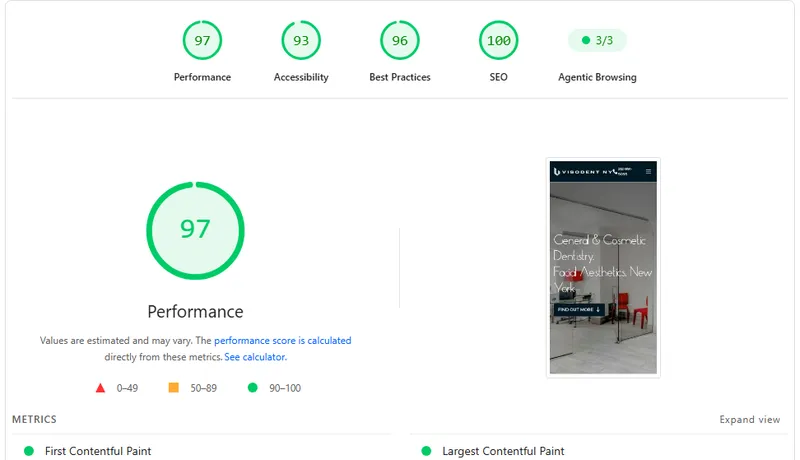
At Infomodus, we faced this exact challenge when working with VisoDent NYC, a premier dental and aesthetic practice located in the heart of Midtown Manhattan. In a market as competitive as New York City, having a slow website is simply not an option.
Our goal was to give the clinic a rich, visually impressive WordPress website with full marketing analytics, review integrations, and smooth booking functionality—without sacrificing loading speed. Instead of relying on generic “one-click” speed plugins, which often break site features, we took a careful, manual engineering approach:
- Custom Theme Architecture: We avoided bloated, pre-made templates and built a clean, custom WordPress theme from scratch. This eliminated thousands of lines of unnecessary background code.
- Script Optimization and Cleanup: We audited every single script running on the site. We removed redundant code and compressed the necessary files so they require minimal data to download, even on a weak cellular connection.
- Controlling the Loading Sequence: This was the most critical step. By default, a browser tries to load everything at once—including heavy tracking pixels, review widgets, and images at the very bottom of the page. We re-engineered the loading sequence so that the most important visual elements and the “Book Appointment” button appear on the patient’s screen almost instantly. Secondary scripts, analytics, and lower-page graphics are programmed to load quietly in the background a fraction of a second later.
The results of this technical fine-tuning, combined with a solid local SEO strategy, were transformative. Within the first year, VisoDent NYC saw its average search ranking jump into the top 10, organic website traffic multiplied 20-fold, and the clinic began receiving a steady, predictable flow of 80 to 150 new patient inquiries every month.
Conclusion
For a modern Medical Doctor or clinic owner, investing in digital marketing without fixing website speed is like pouring water into a leaky bucket. You can spend thousands of dollars on ads and content, but if patients bounce away because your pages load too slowly, you will never see the full return on your investment.
By treating page speed as a priority and properly configuring the technical foundation of your WordPress site, you create a faster path from a local Google search to a booked appointment in your chair.